Currently, plastic is a common material widely applied in most industries, from manufacturing basic items and household appliances to electronic components, and important machinery and equipment. Plastic is divided into two main types based on its origin: "synthetic" and "bio-based". Synthetic plastics originate from crude oil, natural gas, or coal. Meanwhile, bio-based plastics come from renewable products such as carbohydrates, starch, vegetable oils and fats, bacteria, and other biological substances. Among these, synthetic plastics are further divided into "virgin plastic" and "recycled plastic".
In this article, we will explore how virgin plastic pellets are produced.
Virgin Plastic Pellets
Virgin plastic pellets are products generated during the process of fractional distillation of crude oil, through polymerization and polycondensation reactions to form high molecular weight compounds (polymers). After distillation, crude oil yields various products such as gasoline, Diesel oil, lubricants, plastics, bitumen, etc. Among these, plastic only accounts for about 4% of crude oil products.
(see more: Virgin Plastic Pellets)
| Products from Crude Oil | Proportion |
| Gasoline | 42.7% |
| Diesel oil | 27.4% |
| Jet fuel | 5.8% |
| Heavy fuel | 5.0% |
| Asphalt | 4.0% |
| Light fuel | 3.0% |
| Liquid hydrocarbon gas | 2.0% |
| Others (plastics, cosmetics, and textiles) | 10.1% |
Virgin Plastic Pellet Production Process
Fundamentally, most plastics currently used are formed through 4 steps:
- Raw material extraction
- Distillation
- Polymerization
- Pelletization
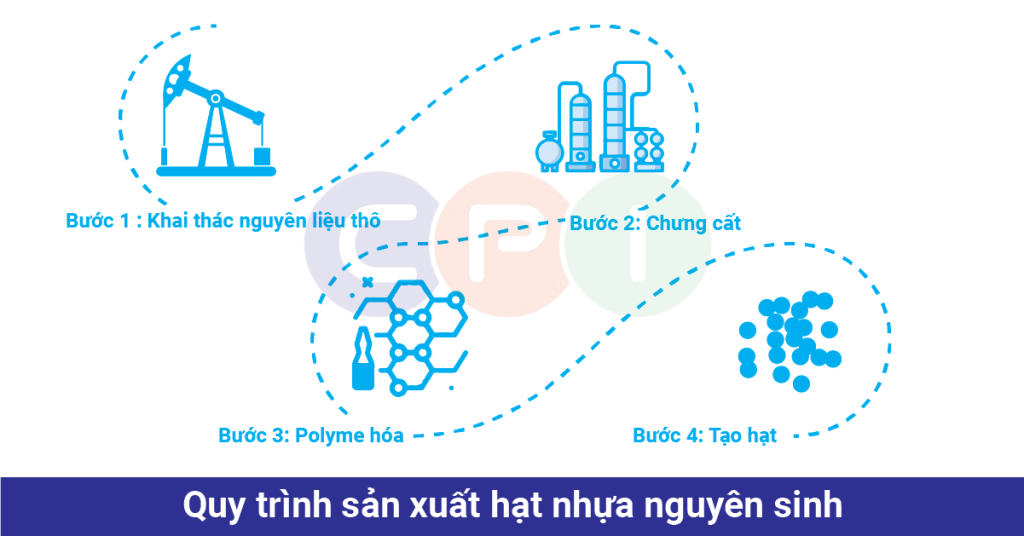
Step 1: Raw Material Extraction
Raw materials are mostly crude oil and natural gas, but also coal. This is a complex mixture containing thousands of compounds that need to be processed afterwards.
Step 2: Distillation
After extraction, raw materials undergo a refining process that transforms crude oil into various petroleum products – these products are then converted to create useful chemicals including "monomers" (a basic molecule of polymers).
In the refining process, crude oil is heated in a furnace, then sent to a distillation unit, where heavy crude oil is separated into lighter components called fractions. One of these, known as naphtha, is a crucial compound for creating a large quantity of plastics. Besides, plastic can also be synthesized from other raw materials such as natural gas.
Step 3: Polymerization
This is a process in the oil and gas industry where light olefin gases (gasoline) such as ethylene, propylene, butylene (monomers) are converted into higher molecular weight hydrocarbons, which are polymers. In this process, monomers are linked into chains. There are 2 different mechanisms for polymerization:
Step 4: Pelletization
In this process, different raw material mixtures are melted and blended together to formulate the plastic. Then, various types of extruders are used to form pellets. Further extrusion or molding processes then transform these pellets into finished or semi-finished products. The pelletization process typically occurs on a twin-screw extruder, where the plastic pellets are then processed into plastic objects of various sizes, shapes, and colors with precise properties under predetermined conditions in the processing machine.
The above is the most common plastic pellet production process today. Through this article, we hope you can better understand how virgin plastic pellets are produced.
If you are looking to buy virgin plastic pellets, come to CPI Plastic. We supply virgin plastic resins such as PE and PP directly imported from reputable manufacturers worldwide. We guarantee competitive prices, stable quality and supply, and long-term cooperation.
Please contact our Hotline: 0913.046.902 for the best quotation.