Currently, plastic items in particular, and plastic products in general, have become an indispensable part of daily life and manufacturing. To produce a plastic product that meets standards or technical requirements, numerous trials, raw material blending, and additive mixing are often needed to develop a production formula. For this reason, plastic compound was born as a solution to simplify the plastic manufacturing process. Let's explore this solution in the article below.
What is Plastic Compound?
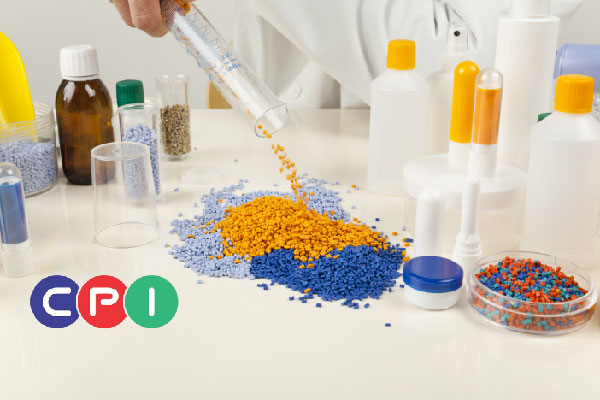
Compound means a mixture or combination. Plastic compound is a product of combining various components from virgin resin, additives, and colorants (Plastic Compounding) to modify and enhance the properties of plastic, helping it achieve desired characteristics. Plastic compounds are in granular form and can be used as the sole raw material for manufacturing plastic products without the need for additional blending. The plastic compound will be produced according to customer requirements, with material components varying based on the customer's technical specifications or sample product.
This plastic compound can be used in almost all areas of plastic manufacturing, depending on the input plastic material.
Additives commonly included in compounds are antioxidants, UV stabilizers, fillers, other property-enhancing agents, and sometimes reinforcing components like fiberglass.
Benefits of Plastic Compound in Manufacturing
Because plastic compound is a type of product custom-processed according to customer requirements, when using PP, PC, ABS, etc. compounds, products will ensure uniformity in both color and properties. Furthermore, using plastic compounds helps reduce manufacturing risks such as incorrect blending ratios or uneven raw material consumption, etc.
Using plastic compounds offers numerous benefits, especially for large-scale production or products with infrequent changes in technical requirements and color.
Key benefits of using plastic compounds in manufacturing include:
Direct production without the need for raw material blending. This saves time in raw material processing, thereby reducing labor costs and increasing productivity.
Finished products will meet exact technical specifications. Plastic compound pellets undergo thorough calculation and testing based on requirements and sample products.
Reduced manufacturing risks such as incorrect blending ratios or uneven raw material consumption leading to production disruptions.
Moreover, by using a single source of raw material, manufacturing enterprises can be more proactive and establish long-term cooperation with specific suppliers, enjoying competitive raw material prices.
Plastic Compounding Process
- Order reception.
- Sample analysis, technical requirement evaluation, testing, and formula development.
- Plastic Compounding.
- Quality control.
At CPI Plastic, the first step when receiving a compound order is to analyze the characteristics and color of the sample product. Then, a formula is developed for trial runs. This process may be repeated several times to ensure the output material fully meets the customer's requirements and technical specifications.
After the testing phase, raw materials are prepared based on the formula developed by the laboratory. Raw materials undergo thorough quality inspection to ensure that the production process and final product meet requirements.
Once the preparation stage is complete, the next step is plastic compounding:
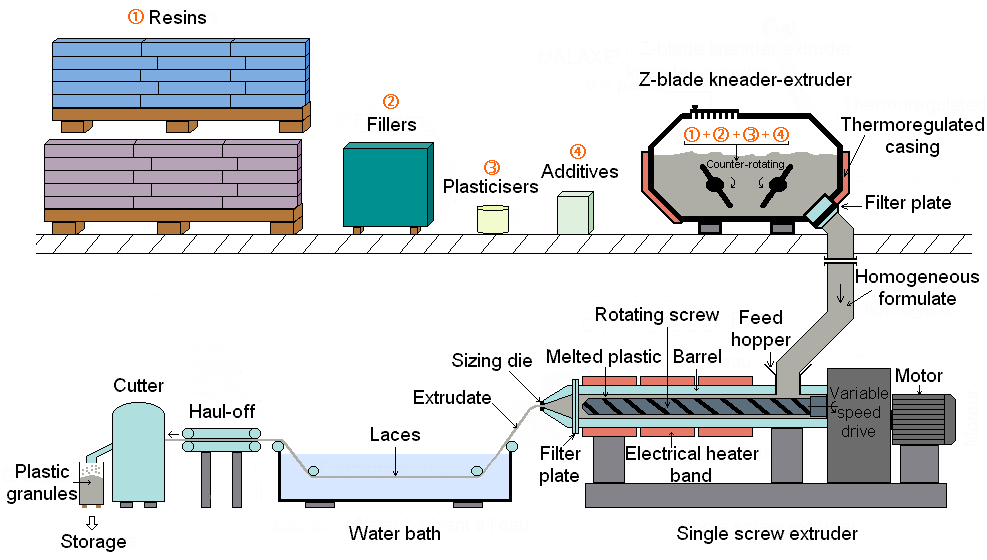
- Raw materials, including virgin resin, additives, colorants, and fillers, are fed into a mixer. Here, the materials are melted and continuously mixed by counter-rotating twin screws.
- After being thoroughly mixed, the compound is passed through a filter head to remove as many impurities as possible. Then, the material is fed into an extruder and further heated to the appropriate temperature before being extruded.
- The molten plastic from the extruder passes through a water bath and is pulled into strands. Here, the water bath temperature is monitored to ensure the plastic strands are cooled to the appropriate temperature. The temperature will affect the stretchability of the strands, or in other words, the size of the strands and the size of the output plastic pellets.
- After cooling, the plastic strands are pulled into a pelletizer. The blades operate at a specific speed to produce plastic pellets of the required size. The newly formed plastic pellets fall into a sieving machine to ensure uniform size of the finished pellets, then they are discharged into storage bins.
- Finally, the finished plastic compound pellets are re-inspected before packaging to ensure consistent quality.
CPI Plastic Vietnam is one of the leading manufacturers of plastic compounds and plastic additives in Vietnam, with 3 large-capacity factories in Ha Nam; ensuring stable supply of high-quality, consistent products. CPI Plastic is a top choice for manufacturing factories that require stability in production volume and quality.
Customers can refer to our plastic compound products here: "Plastic Compound Pellets"